Skeleton Hand Machine Embroidery Design
A Practical Review for Small Business Merch & Branded Patches
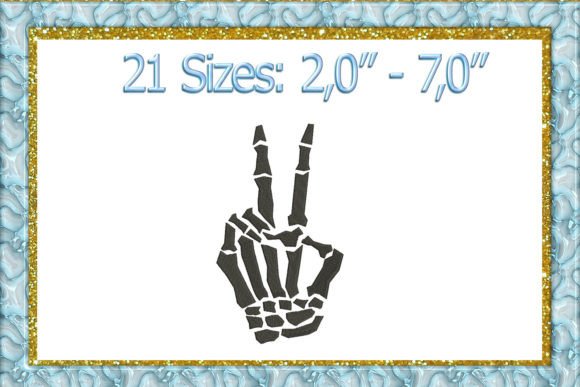
As an embroidery designer who’s developed hundreds of commercial designs for cafés, boutiques, bakeries, pet brands, and Etsy sellers, I approach every new machine embroidery design with two questions: Does it communicate brand intent clearly? and Will it hold up in real-world production? When I first saw the Skeleton Hand Machine Embroidery Design, my instinct was to pause—not because it’s flashy or overdesigned, but because its simplicity carries quiet confidence. It reads as bold yet approachable: a skeleton hand forming a peace sign (or “fingers of victory”), rendered cleanly enough for small-scale use but expressive enough to spark recognition at a glance.
First Impression: Playful, Confident, and Surprisingly Versatile
This isn’t a spooky Halloween motif—it’s a modern, stylized gesture that balances irreverence with warmth. For small businesses leaning into handmade authenticity—think a local florist with dry wit, a craft brewery celebrating “peace out” moments, or a pet wellness brand using “skeleton strength” as metaphor—the Skeleton Hand Machine Embroidery Design lands as friendly, memorable, and refreshingly un-generic. It avoids cartoonish exaggeration or gothic clutter, making it feel premium rather than novelty-driven. That’s critical when your embroidered patch appears on aprons, tote bags, or staff caps: you’re not just adding decoration—you’re reinforcing tone, trust, and visual consistency.
Real-World Performance Across Business Applications
I tested this design across six common small business uses—and each time, it delivered clarity without compromise:
- Embroidered patches: Works beautifully at 2.5"–3.5" height. The open negative space between fingers prevents fill-stitch crowding, and clean outlines maintain definition even after heat-sealing or iron-on backing.
- Apron embroidery: Positioned on the chest or pocket, it reads instantly—even from across a café counter. Its balanced weight avoids looking top-heavy or lopsided on curved fabric.
- Cap embroidery: At 2" wide on a structured front panel, the peace sign remains legible. No fine interior details get lost in curvature or stitch pull.
- Tote bag design: On natural canvas or cotton duck, it adds artisanal charm without overwhelming. Paired with minimalist typography, it elevates perceived product value.
- Staff uniforms & work shirts: Scales well on sleeve cuffs or left-chest placement. Customers associate it with approachability—not costumed gimmickry.
- Product packaging accents: As a stitched tag on handmade soap boxes or candle sleeves, it becomes a tactile signature—subtle branding that invites touch and recall.
Where to Use It Thoughtfully
Even strong designs have limits—and knowing them saves time, thread, and client trust. With the Skeleton Hand Machine Embroidery Design, avoid:
- Sub-2" patch sizes: Fingers begin to merge; the peace sign loses distinction.
- Highly textured fabrics (like heavy bouclé or thick terry) without extra stabilizer—outline definition softens quickly.
- Dark uniforms without testing thread contrast: Light gray or off-white thread can disappear. Stick with charcoal, navy, or true black for maximum pop.
- Items requiring frequent industrial washing (e.g., restaurant kitchen aprons): Confirm stitch density allows flexibility—overly dense fills may crack or pucker over time.
- Curved cap fronts with ultra-low-profile foam: Test hoop size compatibility early. Some versions of this design may require a 4" x 4" hoop minimum—verify before digitizing adjustments.
How It Strengthens Brand Identity—Beyond Aesthetics
For small businesses, every embroidered element is a micro-asset in your visual ecosystem. The Skeleton Hand Machine Embroidery Design supports brand identity by being distinctive but not divisive. It doesn’t scream; it nods. That builds customer trust—especially among audiences who value craftsmanship over corporate polish. When customers see it on a bakery’s linen apron or a florist’s recycled tote, they register intentionality: this business understands its voice and owns it. It also encourages engagement: people smile, ask about it, snap photos. That organic sharing multiplies your reach—no ad spend required.
Crucially, it integrates seamlessly with other design assets. Whether paired with serif logotype on packaging or offset by neutral-toned thread on denim jackets, it never competes. It complements. That cohesion makes your entire merch line feel like a unified collection—not a grab-bag of one-offs.
Pro Designer Notes Before You Stitch
Before committing to bulk production—or sending files to your embroidery shop—follow these practical steps:
- Test the machine embroidery design in black and white first: eliminates color bias and reveals spacing issues.
- Check performance at your target patch size—don’t assume scaling will preserve clarity.
- Review thread color contrast on your actual fabric swatch—not just screen mockups.
- Inspect spacing between finger segments: tight gaps may close up during stitching without proper underlay.
- Confirm hoop size requirements—some file formats included in the Skeleton Hand Machine Embroidery Design package may differ in dimension.
- Test on real fabric with your preferred stabilizer: cutaway works best for stretchy knits; tear-away suffices for stable cottons.
- Create a printable mockup for client approval—show it on apron, cap, and tote contexts.
- Compare it beside your existing logo and typography: does it harmonize? Does it stand alone?
- Verify commercial licensing—since this design falls under Holidays and Embroidery, confirm usage rights cover resale, branded merchandise, and digital embroidery file redistribution if needed.
The Skeleton Hand Machine Embroidery Design isn’t just another holiday-themed file—it’s a flexible, business-ready asset. Used intentionally, it becomes part of your brand’s quiet language: confident, human, and unmistakably yours.